
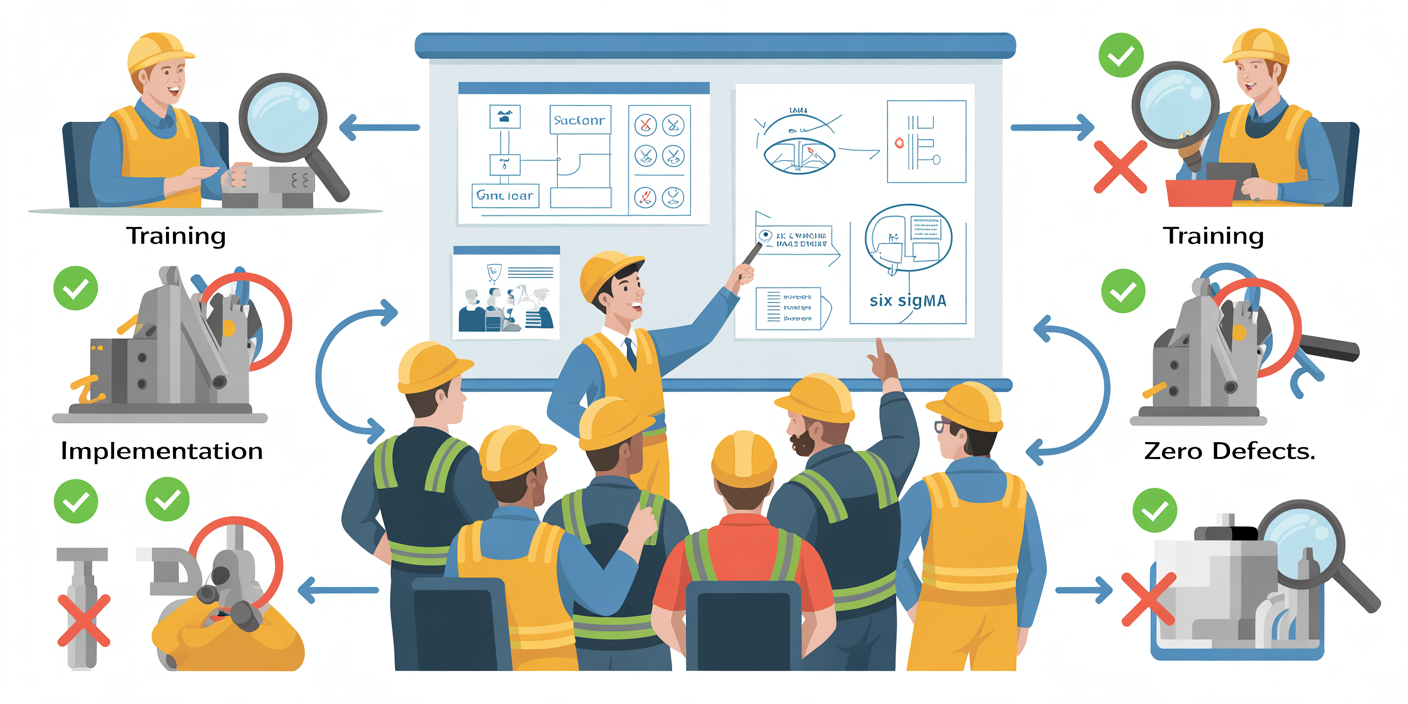
Every defect costs you twice: once to build it wrong, again to fix it. Yet most organisations accept rework as inevitable rather than addressing the root causes. Quality management training shifts this mindset from firefighting to prevention, embedding quality into processes rather than inspecting it in afterward.
What Is Quality Management Training?
Quality management training equips teams with systematic approaches to preventing defects, reducing variation, and building quality into every stage of production or service delivery. This isn’t about quality departments catching mistakes. It’s about everyone understanding how their work impacts quality and having tools to improve it.
The scope extends beyond manufacturing. Service organisations need quality management just as urgently. When your customer service team handles inquiries inconsistently, that’s a quality issue. When your finance department makes preventable errors in reporting, that’s a quality issue. When your IT team releases software with predictable bugs, that’s a quality issue.
Effective quality assurance training addresses both technical methods and cultural mindset. Teams need to understand statistical process control, root cause analysis, and quality control methods. But they also need to embrace continuous improvement, speak up about problems, and take ownership of quality outcomes. Technical knowledge without cultural shift produces limited results.
Building a Prevention Mindset
The fundamental shift quality training creates is from reactive to proactive thinking. Instead of asking “How do we fix this defect?”, teams learn to ask “How do we prevent this defect from occurring?” This simple reframing changes everything.
Prevention requires understanding why defects occur. Are specifications unclear? Do processes lack standardisation? Are people inadequately trained? Are materials inconsistent? Is equipment poorly maintained? Quality management training provides frameworks for systematic investigation rather than jumping to surface-level fixes.
What Are the Four Types of Quality Management?
Understanding these four approaches helps organisations select methods that match their context and maturity level. Each serves different purposes and requires different capabilities.
Quality Planning: Setting Standards
Quality planning establishes what “good” looks like before work begins. This means defining specifications, identifying critical quality characteristics, and determining how you’ll measure success. Without clear quality planning, teams operate with different assumptions about acceptable standards.
This connects directly to project management capabilities. Quality requirements need integrating into project plans from the start, not addressed as afterthoughts. When quality planning happens late, teams build the wrong thing correctly rather than the right thing from the beginning.
Quality Control: Checking Conformance
Quality control involves monitoring outputs against standards and taking corrective action when deviations occur. This includes inspection, testing, and measurement activities that verify whether products or services meet requirements.
Whilst necessary, control alone is insufficient. Catching defects before they reach customers is better than not catching them at all, but preventing defects is better still. Organisations that rely primarily on inspection rather than prevention incur unnecessary costs and limit their quality potential.
Quality Improvement: Continuous Enhancement
Quality improvement focuses on systematically enhancing processes to reduce defects, decrease variation, and improve capability. This is where methodologies like Six Sigma, Lean, and business process improvement approaches demonstrate their value.
Improvement isn’t about occasional breakthrough projects. It’s about creating systems where teams continuously identify and eliminate sources of poor quality. When improvement becomes how your organisation operates rather than special initiatives, quality compounds over time.
Quality Assurance: Building Capability
Total quality management training emphasises assurance, which means building quality into processes so defects become unlikely rather than just caught quickly. This requires process design, training, and systems that support people in doing quality work.
Assurance recognises that quality isn’t primarily about catching mistakes. It’s about creating conditions where mistakes are difficult to make. This might mean mistake-proofing processes, designing clearer work instructions, or providing better tools and training. Investment in assurance reduces the need for control.
What Are Examples of Quality Management?
Quality management manifests differently across industries, but principles remain consistent. Look at how these approaches create tangible impact.
Manufacturing Excellence
A manufacturing operation implementing quality management might start by mapping their process to identify where defects originate. They discover that 60% of quality issues trace to three specific process steps. Rather than increasing inspection, they analyse why those steps produce defects.
Investigation reveals inconsistent work methods, inadequate training for new operators, and equipment that drifts out of specification between maintenance cycles. Addressing these root causes through standardised procedures, enhanced training, and preventive maintenance reduces defects by 70% without adding inspection staff.
Service Delivery Consistency
A professional services firm applies quality management to client deliverables. They notice that project outputs vary significantly depending on which team member leads the work. Some consistently deliver excellent results whilst others produce work requiring extensive revision.
Rather than accepting this variation, they develop clear quality standards, create templates that embed best practices, establish peer review processes, and implement training so everyone reaches a consistent standard. Client satisfaction improves and internal rework decreases substantially.
Administrative Process Accuracy
An organisation’s finance team struggles with errors in monthly reporting. Mistakes require time-consuming corrections and undermine confidence in the data. Instead of just trying harder, they apply quality control methods to understand error patterns.
Analysis reveals most errors occur during data transfer between systems. They implement validation checks, create error-proofing templates, and automate routine calculations. Error rates drop dramatically and the team redirects time from correction to analysis that adds value.
Building Quality Into Your Culture
The real quality revolution happens when quality thinking becomes embedded in how people work, not just what quality departments do. This cultural transformation requires more than training courses.
Leadership Must Demonstrate Priority
When leaders consistently prioritise schedule over quality, talk about quality but reward speed, or tolerate known quality issues to meet short-term targets, teams learn that quality isn’t truly important. Actions speak louder than quality statements.
Leadership commitment means allocating time for quality improvement, celebrating quality achievements as prominently as productivity gains, and refusing to ship known defects even under deadline pressure. These decisions signal whether quality is genuinely a priority or just something you say matters.
Empower Everyone to Stop and Fix
In quality-focused cultures, anyone can stop production or service delivery when they identify a quality problem. This seems risky until you recognise that continuing to produce defective output is far more expensive than pausing to address root causes.
This empowerment requires trust. People need confidence they won’t be punished for highlighting problems or slowing down to get things right. When organisations shoot messengers or pressure teams to overlook quality concerns, they guarantee those concerns won’t be voiced until they become crises.
Make Improvement Systematic
Quality improvement can’t depend on heroic individual efforts or occasional initiatives. It needs systematic approaches embedded into regular operations. This might mean dedicating time in team meetings to discuss quality issues, establishing routine process reviews, or creating structured problem-solving approaches.
Investment in comprehensive quality management training provides these systematic methods. Teams learn structured approaches to identifying problems, analysing causes, implementing solutions, and verifying effectiveness. These capabilities transform quality from hoping things go well to making things go well.
Understanding the True Cost of Poor Quality
Many organisations dramatically underestimate quality costs because they only count obvious expenses like rework, scrap, and warranty claims. The hidden costs often exceed visible ones.
What You’re Not Measuring
Customer goodwill lost through disappointing experiences doesn’t appear in quality cost reports but impacts future revenue. Employee time spent firefighting recurring problems rather than improving processes represents massive opportunity cost. Rush charges to expedite replacement materials for defective items add up. Capacity consumed by rework limits your ability to serve new customers.
When you properly account for quality’s total cost, investing in prevention becomes obviously economical. Spending on total quality management training, process improvement, and defect prevention pays for itself many times over through eliminated waste and freed capacity.
Achieving First-Time-Right Performance
The goal isn’t perfection, it’s building processes so robust that defects become rare exceptions rather than expected occurrences. This transformation doesn’t happen overnight, but organisations that commit to systematic quality management see measurable progress within months.
Success requires technical capability and cultural commitment. Your teams need to understand statistical methods, problem-solving tools, and process analysis techniques. But they also need psychological safety to identify problems, authority to implement improvements, and leadership that genuinely values quality over expedience.
Ready to build quality into your processes rather than inspecting it in afterward? Get in touch to discuss developing quality management capabilities that transform your organisation from firefighting defects to preventing them.